Message from the President
Northland Pioneer College (NPC) stands at a pivotal moment—one shaped by both urgent challenges and extraordinary opportunity. Serving a vast and diverse region across Navajo and Apache counties, NPC is uniquely positioned to transform lives through education while strengthening the economic, civic, and cultural fabric of Northeastern Arizona. This strategic framework reflects our commitment to student-centered excellence, institutional integrity, innovation, and deep community partnership.
At the heart of this plan is an unwavering focus on enduring student success. Current data underscore the need for decisive action: NPC’s student retention and persistence rates lag behind peer institutions, and students consistently identify barriers such as childcare, transportation, financial instability, and limited access to support services as obstacles to completion. In response, NPC will implement targeted, data-informed, and student-centered initiatives that prioritize relational advising, guided pathways, high-impact educational practices, expanded childcare and transportation access, and a culture of care and belonging. By 2030, our goal is to achieve a 72% term-to-term persistence rate, increase credential and degree completion, and significantly improve student satisfaction.
👉 MESSAGE FROM THE PRESIDENT CONTINUED... READ MORE
Complementing these efforts is a strategic emphasis on enrollment growth and access. As public perceptions of higher education shift and competition for traditional students intensifies, NPC will strengthen recruitment, engagement, and financial support strategies for both traditional and adult learners. Through enhanced high school partnerships, Promise Program financing, flexible scheduling, employer-supported education, and expanded apprenticeships, NPC will grow unduplicated headcount and Full-Time Student Equivalent (FTSE) enrollment by at least 3% annually. Equally important, we will expand equitable access to historically underserved populations by investing in college readiness, online and place-based learning, culturally responsive supports, and community-wide planning.
Achieving these outcomes requires a foundation of institutional excellence and stewardship. Following several years of leadership transition and operational disruption, NPC is committed to rebuilding trust, strengthening morale, and aligning resources with mission and strategy. Through continuous quality improvement, transparent budgeting, organizational alignment, and intentional recruitment and retention of a diverse workforce, NPC will become an employer of choice and a more effective, sustainable institution. By 2030, we aim to earn national recognition as a Great College to Work For while maintaining below-average employee turnover.
NPC’s role as a community anchor institution is central to this vision. We will forge and strengthen partnerships with alumni, families, schools, employers, tribal nations, nonprofits, and public agencies to ensure our programs remain responsive and relevant. By expanding community-based learning, employer partnerships, and organization-supported education, NPC will enhance workforce readiness, support living-wage attainment, and increase the perceived value of the college as a trusted regional asset.
Finally, this plan boldly embraces innovation and creativity. In a rapidly changing educational and economic landscape, NPC will foster a culture of entrepreneurial thinking, interdisciplinary collaboration, and data-informed decision-making. Investments in technology, academic program development, online and hybrid delivery, and innovation incubators will ensure our learners have access to relevant credentials, modern infrastructure, and transformative educational experiences. By 2030, NPC will launch new interdisciplinary programs, expand industry-aligned certificates, and significantly increase learner engagement, retention, and completion.
Together, these strategic priorities reflect a unified vision: to place students at the center of everything we do, steward our resources responsibly, innovate with purpose, and partner deeply with our communities. Guided by this plan, Northland Pioneer College will not only meet today’s challenges, but will shape a more prosperous, and hopeful future for the region we proudly serve.
COLLEGE MISSION:
Northland Pioneer College provides educational excellence that is affordable and accessible for the enrichment of communities across northeastern Arizona.
NPC continually responds to the needs of our communities by cultivating generations of learners. By 2030, NPC will transform lives by advancing student success and socio‐economic well‐being through a spirit of innovation, partnership, and creative problem-solving.
NPC will live our vision through the following Shared Values. At NPC, we value:
Integrity
By Integrity, we mean consistently taking responsibility for our actions and preserving the trust communities place in us. We demonstrate Integrity by:
- Setting achievable and measurable goals.
- Maintaining transparency in project planning, implementation, and reporting while honoring the college’s shared governance process.
- Being consistently truthful and fair in our internal and external interactions.
Inclusion
By Inclusion, we mean empowering all people – regardless of individual differences and/or historical under-representation – to have the right to be involved, engaged, respected, and appreciated as valuable members of our communities. We demonstrate Inclusion by:
- Ensuring all individuals, regardless of race, color, religion, national origin, gender, or sexual orientation have opportunities to equitably engage with, participate in, and benefit from the NPC community.
- Recruiting individuals and partnering with organizations that reflect and represent the diverse backgrounds, perspectives, and interests of our area.
- Using diverse perspectives to make better-informed decisions.
Adaptability
By Adaptability, we mean a commitment to being agile in responding to the ever-changing needs of our diverse communities through collaboration, innovation, and informed risk-taking. We demonstrate Adaptability by:
- Keeping an open mind to learn or develop new ways to respond to changes.
- Experimenting with different styles of working and adjusting as needed.
- Using valid and reliable data to make decisions with confidence and efficiency.
Civility
By Civility, we mean maintaining one’s own beliefs and perspectives without demeaning the beliefs and perspectives of others. We demonstrate Civility by:
- Using active listening and acknowledgment without judgment while interacting with others, even when there are deep-rooted and fierce disagreements.
- Seeking common ground as the starting point for dialogue about differences.
- Modeling, teaching, and promoting the practices of civility and expecting others to do the same.
Access
By Access, we mean striving to minimize barriers to lifelong learning. We demonstrate Access by:
- Striving to keep costs low and connect students with available resources and financial support.
- Offering education, student services, information, and resources in multiple formats to optimize equitable opportunities across our communities.
- Implementing the principles of universal design to promote access to campus spaces, events, and activities.
Strategic Planning Process
Our strategic planning process followed a structured, evidence-based approach designed to ensure the institution’s mission, values, and long-term goals remain responsive to both internal priorities and external realities. The process began with the Scan & Analyze step, in which teams conducted a comprehensive review of NPC’s mission, vision, and values while gathering broad-based feedback from stakeholders, including students, employees, and community members. This phase also included an environmental scan and a study of industry trends to provide a clear picture of where the college currently stands in terms of challenges, opportunities, and institutional capacity.
Building on this foundation, the Direction step identified where the college aims to go. Strategic directions were developed based on key findings from the scan and stakeholder engagement. Long-term goals with corresponding metrics were developed to ensure progress toward desired outcomes. With goals and metrics defined, the Strategies & Action Plans step focused on how to achieve them. Annual action plans are then developed to be integrated with budgeting processes to ensure they are resourced and feasible.
Finally, the Monitor & Report step ensures that the strategic plan remains a living document. The college developed processes to communicate the plan broadly, monitor ongoing progress through key metrics, and evaluate success through regular reviews and updates. This phase reinforces accountability, transparency, and continuous improvement, helping ensure that NPC’s strategic plan translates into meaningful institutional outcomes and sustained student success.
STRATEGIC PLANNING TIMELINE >
Strategic Planning Timeline
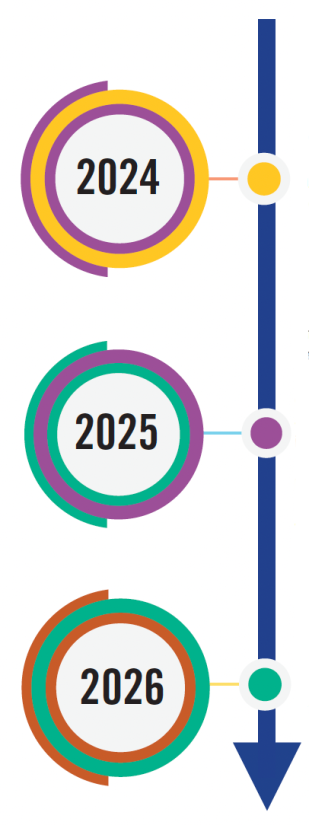
Planning & Process Setup (January 2024)
Established the foundation for an inclusive and strategic planning process by defining shared governance roles, setting expectations for feedback and decision-making, reviewing best practices, and drafting the structure of NPC’s new strategic plan.
Data Gathering & Engagement (February–May 2024)
Collected and analyzed internal and community input through focus groups and surveys, aligned feedback with the planning calendar, and shared progress and alignment updates with the Extended Cabinet.
Initial Analysis & Drafting (June–August 2024)
Reviewed data and existing priorities through leadership retreats, refined carryover action items, and prepared draft strategic directions for shared governance review in early fall.
Finalizing Strategy & Year One Development (September–December 2024)
Finalized the strategic direction through presentation to the District Governing Board, and established first-year (Academic Year 25-26) priority actions through Leadership Council and Deans/Directors retreats. Budgetary needs associated with these actions were identified to inform Fiscal Year 25-26 planning.
Final Approval & Implementation Preparation (January–December 2025)
Secured formal approval of the 2025–2030 Strategic Plan by the District Governing Board, finalized long-term metrics and strategies, and aligned college calendars, budget planning, and assessment cycles to support implementation. Developed communication, rollout, and integration plans in preparation for the January 2026 launch.
Monitor & Report: Review Progress and Adapt (Ongoing)
Continuously monitored implementation through regular reporting, including monthly updates to the President’s Cabinet and District Governing Board, quarterly stakeholder updates, and annual reviews of strategic outcomes to inform adjustments and continuous improvement.
To bring structure and accountability to our strategic plan, we adopted a framework to clearly connect our vision with measurable outcomes.1 Beginning with the end in mind, the framework serves as a road map that outlines how our inputs lead to activities, which produce outputs, and ultimately generate outcomes and long-term impacts. This approach ensures that our priority action items are not only aligned with institutional goals but also grounded in data-informed decision-making.
This structured approach allowed us to clearly identify the problem areas impeding institutional effectiveness such as inconsistent student services, unclear internal processes, and financial inefficiencies and to translate these challenges into actionable goals with defined metrics.
| INPUTS | OUTPUTS | OUTCOMES |
|---|---|---|
| Resources used to implement strategy, including staff, funding, partnerships, technology, and time. | The direct deliverables (e.g. number of sessions, tools produced, individuals reached). | The short- and medium-term results (e.g. changes in knowledge, attitudes, behaviors, or capacity). |
ONGOING PLANNING >
Ongoing Planning
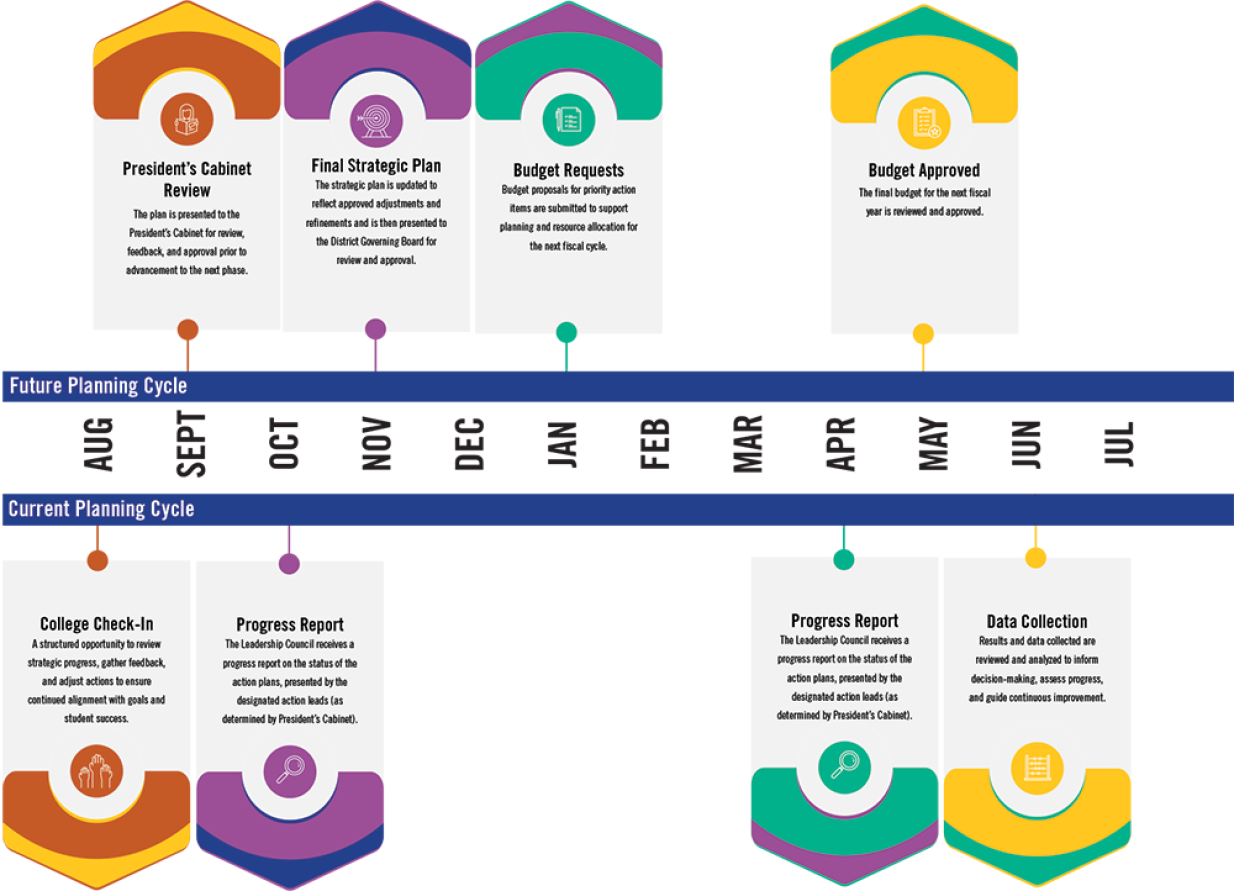
Annual planning is critical to ensuring the strategic plan remains actionable, responsive, and aligned with institutional priorities while progress on the current plan is actively monitored. A structured assessment and planning timeline supports data-informed decision-making, continuous improvement, and clear accountability across the college. Regular data review, stakeholder feedback, leadership review, and governing board approval ensure that adjustments are intentional and well-timed. Ongoing implementation reporting keeps leadership informed of progress and challenges, while early submission of implementation plans and budget requests allows the college to align resources effectively to support strategic priorities.
Strategic Direction:
Facilitating Enduring Student Success (SS)
Northland Pioneer College supports long-term, individualized student success both inside and beyond the college by providing rigorous and carefully assessed programs and courses, and by building lasting relationships that help students identify and adjust their goals, and access resources that help them persist and overcome obstacles
SS 1: Student Persistence & Retention
SS 1: Student Persistence & Retention
By 2030, NPC will increase student persistence and retention by implementing targeted, data-informed, and student-centered initiatives that lead to effectively supporting students in meeting their completion goals.
Problem Statement: Student retention rates for NPC students are some of the lowest in the country, including against like institutions. NPC has the lowest retention rates of all community colleges in Arizona according to the 2021 Strategic Vision Outcomes Report produced by the Arizona Community Colleges Organization. Retention rates are directly and positively correlated with completion rates for college students. Based on prior surveys regarding childcare access, students indicate that lack of care is a significant barrier to course and program completion. National data indicate transportation challenges (lack of adequate vehicle, distance, money for gas/repairs) have also been cited as barriers to consistent attendance in classes that require travel.
Current Priority - Strategy SS1.1
Develop and implement a comprehensive student retention strategy that might include implementing relational advising, program retention plans, increased faculty-student engagement, learning communities infrastructure development, guided pathways mapping and resource connection with One Stop Student Services.
Strategy SS1.2
Expand childcare and transportation access across campuses.
Strategy SS1.3
Cultivate student connections, a culture of care, and sense of belonging that might include the development of student spaces and connection to institutional and community resources.
Current Priority - Strategy SS1.4
Cultivate sustainable plans for high-impact practice integration that might include early momentum projects (focus on 1st-year math and English courses), expanding the concurrent requisite model, learning communities participation and IET implementation
OUTCOMES:
By the end of each academic year, achieve an incremental increase in retention and satisfaction rates among targeted student populations, as measured through institutional research data, program participation tracking, and annual student RISC surveys. Annually increase on-time credential and degree completion and a 10% increase in student satisfaction (based on IE baseline data). By 2030, attain a 72% rate of term-to-term persistence.
SS 2: Increase Enrollment
SS 2: Increase Enrollment
By 2030, NPC will significantly increase enrollment of traditional and adult students.
Problem Statement: Current enrollment make up of NPC consists of nearly 40% high school students and 60% adult students. Value in education is decreasing, and those students who are viewed as college-bound are often encouraged to go directly to a university.
Current Priority - Strategy SS2.1
Implement systematic and comprehensive recruitment and student engagement initiatives that might include high-impact high school student recruitment effort to improve conversion rates of high school students to NPC students and development of enrollment navigation strategies.
Strategy SS2.2
Develop a comprehensive financial support strategy to ensure all students have access to a high-quality post-secondary education through possibly providing Promise Program financing that might also focus on Arizona General Education Curriculum (AGEC) completers.
Current Priority - Strategy SS2.3
Develop a comprehensive plan for developing and supporting student spaces that can help promote student engagement, socialization, study and/or housing options.
Strategy SS2.4
Partner with community stakeholders to develop initiatives for organization-supported education that may promote employer partnerships and employer supported education, expansion of project-based learning opportunities and apprenticeships, and collaborations with groups like AZ@Work, local non-profits, faith-based organizations and Arizona state agencies.
Strategy SS2.5
Assess and evaluate program offerings to ensure alignment with mission and community needs through development of an academic master plan, non-traditional course scheduling, use of apprenticeships/Prior Learning Assessments (PLA), and pursuing Strengthening Community College and other grant opportunities.
OUTCOMES:
Increase student enrollment of unduplicated head count of traditional and adult students by 3% annually. Increase Full-Time Student Equivalent (FTSE) of traditional and adult students 3% annually.
SS 3: Educational Access
SS 3: Educational Access
By 2030, NPC will expand educational access to a broad range of student populations across Northeastern Arizona to ensure equitable participation in high-quality education and opportunities.
Problem Statement: Across Navajo and Apache Counties, groups of people have been historically excluded from high-quality educational experiences due to a variety of personal or systemic barriers including geography, finances, or governmental interference.
Strategy SS3.1
Expand college readiness initiatives and pathways to address barriers for various student populations that might include improving of online learning access, providing post-secondary information and financing options for parents often and as early as middle school, improving school climate and eliminating exclusionary practices that hinder college preparation while implementing early planning/preparation programs that includes the entire community.
Strategy SS3.2
Research and evaluate population area needs and interests in accessing educational attainment that aim to address and remove barriers and explore proactive usage of Title III supports
Current Priority - Strategy SS3.3
Strengthen individually responsive supports college-wide that might include strategic faculty and staff recruitment, innovative instructional and assessment practices, and referrals for services, clubs and organizations.
OUTCOMES:
By 2030, 85% of courses taken by first-time students in their first semester will be completed successfully with a grade of “C” or better (measured by home location). Increase enrollment by 3% annually for each campus/center location.
Short-term outcomes that will contribute to the above outcomes may also include increasing the number of students completing 6 or more college-level credits in their first semester, increasing the number of students completing English 101 and Math 109 in their first year, an increase in students taking placement tests in their first semester, increased utilization of financial aid with completion of the Free Application for Federal Student Aid (FAFSA), increased participation in academic support services and improved transfer rates to the state’s public universities.
Cultivating Institutional Excellence (IE)
Northland Pioneer College cultivates and sustains a healthy, value-driven institutional culture that incorporates continuous, fiscally responsible and data-informed integrated strategic planning, effective shared governance, clear internal processes and constructive communication, to support student success and sustain productive relationships within the NPC community and the communities it serves.
IE 1: Stakeholder Partnerships
IE 1: Stakeholder Partnerships
By 2030, NPC will forge new and strengthen current partnerships between the college and community stakeholders that enhance our students’ economic well-being, quality of life, and societal progress.
Problem Statement: Through focus groups and community surveys, a clear theme of “lack of institutional presence” was uncovered. NPC is too often not viewed as a partner or organization with expertise to support the community. Building stronger partnerships with the families, schools, and businesses within the communities we serve is essential for sustainability and being seen as a community asset.
Current Priority - Strategy IE1.1
Create, implement, and sustain an alumni engagement initiative that may include development of a data strategy such as using the graduation application to capture future contact information and development of a communication strategy to gauge ongoing interest in events and possible willingness to participate in mentor relationships with current NPC students.
Current Priority - Strategy IE1.2
Enhance NPC’s presence and value within communities and among community members such as offering open spaces for community events, partnering to sponsor community events, and increasing participation in community events.
Strategy IE1.3
Build NPC’s identity as a value-added community resource and asset by engaging as an active participant with organizations across the region.
OUTCOMES:
By 2030, NPC will improve administrative efficacy and institutional sustainability through strategic alignment of college resources, processes, and organizational structure.
IE 2: Efficiency & Sustainability
IE 2: Efficiency & Sustainability
By 2030, NPC will forge new and strengthen current partnerships between the college and community stakeholders that enhance our students’ economic well-being, quality of life, and societal progress.
Problem Statement: NPC has undergone significant leadership turmoil over the last 5 years. This has led to implementation of work in silos and without effective overarching support. Furthermore, multiple infrastructure changes have been implemented without regard for system planning, implementation, or current procedures. Trust in leadership has decreased over the last three years according to the Great Colleges survey data, and while employees generally believe they are contributing to the public good, morale and employee satisfaction are lacking
Current Priority - Strategy IE2.1
Implement a comprehensive continuous quality improvement initiative that ensures all NPC practices and infrastructure components are both efficient and effective which may include institutional reorganization, development of departmental handbooks, alignment of master plans, transparent and equitable budgeting as part of resource planning, and consistent revision and review of procedures and initiatives that includes embedded fiscal and resource planning.
Current Priority - Strategy IE2.2
Ensure that all structures are in place to make NPC a great place to work and an employer of choice that may include the development of recruitment and retention strategies to better reflect the communities we serve, supporting the maintenance of historical knowledge, and implementing an exit survey process to understand reasons for employees leaving NPC.
OUTCOMES:
By 2030, NPC will be named in at least one recognition category of the Great Colleges to Work For survey. Improve survey results by 5% across all categories for two consecutive years while maintaining below average turnover.
Glossary
A Living Document
This plan, together with our future institutional master plans (Academic, Facilities, Technology), reflects the collective vision and contributions of individuals across the entire institution. It outlines our big ideas and planned activities while providing a framework for continuous evolution. We will regularly review our institutional plans to ensure they effectively align with and support our goal attainment. This strategic plan is intended as a living document, built with nimbleness and flexibility in mind. While laying a strong foundation for growth and impact, it is also designed to respond to emerging challenges and opportunities. Implementation plans for each of the strategic priorities will be developed next, ensuring we can meet the long-term goals identified in this document.
We are committed to ongoing, continuous monitoring of our progress through careful measurement and evaluation of effectiveness. Annual planning sessions will bring together the Board, Administrators, Deans, Directors, and other key members of the campus community to review progress, make adjustments, and reaffirm prioritized strategies.
As we look to the future, the institution will continuously engage both internal and external communities, including our students, local communities, and business and industry partners, evaluating our mission and vision while ensuring our values are reflected in all that we do. We extend our gratitude to the many individuals across the institution who contributed to the development of this framework, keeping our students at the center of our work. Particular thanks go to the core and ad hoc members of the Leadership Council, President Lawson, and the District Governing Board for their guidance and support, as well as to our community members and business and industry partners whose input and collaboration were invaluable.
As we enter this period of action, we look forward to working with all members of our community, including our partners in business and industry, as we advance our strategic priorities in the years ahead.
The 2025-30 Strategic Plan was adopted by the Navajo County Community College District Governing Board in May 2026.
- Download print version: 2025 - 2030 Strategic Plan
- Other strategic plans